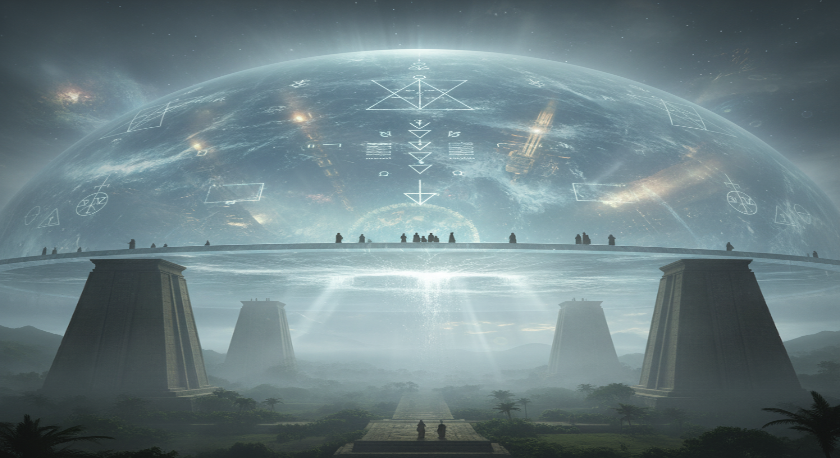
The Blueprint of a Lost Heaven
Before the simple description of sky and water in our modern scriptures, the oldest civilizations conceived of the heavens as a highly structured, even tangible, dome—a cosmic membrane separating the orderly Earth from the dangerous, primordial waters above.
This ancient celestial structure is known as the Firmament, or Raqi’a in Hebrew cosmography. It was not merely the air we breathe; it was an energetic, solid boundary—the divine architecture that kept chaos at bay. The concept of the Firmament is crucial to understanding the spiritual state of the pre-flood world, suggesting that humanity once lived under a completely different sky. This raises a profound question: what happened to this divine structure, and do the myths of its destruction correlate with massive global events, such as the Catastrophic Cosmology surrounding the Moon’s arrival?
Cosmic Membranes Across Cultures
The idea of the Firmament is a global, shared memory, indicating a common origin or shared experience among early civilizations. By examining the sacred texts of vastly separated cultures, we can begin to reconstruct a unified image of this lost sky.
The Sky-Oceans of the Vedic Tradition
In Vedic and Hindu cosmologies, the celestial realm is often described as a vast, oceanic expanse—a sky-ocean (the ākāśa) that required strong architectural support. The seven heavens, or lokas, were tiered structures separated by these cosmic waters, suggesting a layered universe that had to be contained to prevent inundation. The gods themselves were the navigators and maintainers of these boundaries, constantly struggling against forces that threatened to breach the celestial containment and bring ruin.
The Celestial Domes of Egypt and Sumer
The Egyptians depicted the sky goddess Nut arching over the Earth, swallowing the Sun each evening and giving birth to it each morning. She was the arched container, the physical dome of the sky. Similarly, Sumerian and Babylonian myths describe the heavens as crafted from the split carcass of the primordial goddess Tiamat, solid and structured. This concept of a fixed, physical ceiling strongly contrasts with modern, open-space astronomy and hints at a different pre-historical reality, reinforcing the notion that the ancient sky had a definitive boundary.
The Waters Above and Forbidden Knowledge
The Hebrew account of Genesis is explicit: God made the Firmament “and separated the waters which were under the firmament from the waters which were above the firmament.” This separation is the key to understanding the Firmament’s purpose—it was a shield, protecting the Earth from a dangerous external element. The breach of this shield is intimately linked to the cosmic corruption detailed in other ancient texts.
The Watchers and the Breached Seal
The Book of Enoch and the Book of Jubilees place the destruction of the primeval order squarely on the shoulders of the Watchers—celestial beings who taught mankind Forbidden Knowledge. Their teachings—astronomy, metallurgy, and enchantment—introduced spiritual imbalance that was so profound it may have caused a physical rupture in the cosmic structure. The myth suggests that the divine boundary was compromised by forbidden acts, leading to a cataclysmic flood that purged the world. The consequences of this corruption, and how it directly led to the cosmic reset, are explored further in The Watchers and the Weavers: How Forbidden Knowledge Shaped the Heavens.
A Loss of Immortality
Scholars have suggested that the Firmament acted as a literal barrier, perhaps a magnetic or energetic field, that shielded Earth from specific cosmic radiation. If this shield was intact, it might explain the myths of extreme longevity found in antediluvian records. When the Firmament was destroyed, this protective “dome” was lost, exposing humanity to the harsh reality of cosmic forces and shortening the lifespan. The destruction of the Firmament, therefore, symbolizes humanity’s separation from a previous state of grace and its forced entry into the harsh, modern world.
The Pre-Lunar Chronology Connection
The catastrophic event that led to the Firmament’s rupture must have been of immense scale—one that reshaped the entire celestial architecture. This chronology places the destruction of the Firmament squarely in the same window of time as the great celestial upheaval: the arrival of the Moon.
The Celestial Cataclysm
If the Firmament was a tangible layer of water vapor or an atmospheric envelope, its violent destruction would have been the ultimate act of Catastrophic Cosmology. This type of event aligns perfectly with the ancient accounts that speak of a time when the Moon was not yet in the sky—a Pre-Lunar Chronology described in detail in our Moon Before Time article. It is highly plausible that the arrival of a massive celestial body—or the cosmic events associated with its capture or stabilization—would have had the necessary gravitational and energetic power to compromise and destroy the Firmament, leading to the floods, atmospheric shifts, and planetary chaos that are universally recorded.
Genesis as an Aftermath Report
The Genesis account, rather than being a record of the initial creation, can be read as a report on the re-establishment of order following a profound cataclysm. After the flood and the destruction of the Firmament, the scriptures record the fixing of the great lights (Sun and Moon) in the sky. This act is the celestial repair work. The creation of the Moon and the stabilization of the cycles were necessary to impose order on a broken cosmos. The accounts of When the Moon Was Born directly support this, detailing the violent celestial birth that necessitated the reconstruction of the heavens.
The Spiritual Boundary Today
The concept of the lost Firmament provides a potent framework for interpreting humanity’s place in the cosmos. It suggests that the boundary between “Heaven” and “Earth” was once far less distinct, and that we now live in the aftermath of a cosmic divorce.
The Search for Lost Technology
If the Firmament was a technological or energetic shield, then our current scientific pursuit of lost civilizations is also a search for the Forbidden Knowledge necessary to understand (and perhaps rebuild) that ancient boundary. The mystery of the Firmament transcends simple theology, forcing us to consider a time when the sky itself was architecture—a feature of a lost, high civilization.
Final Thought:
The lost Firmament is the sacred memory of cosmic wholeness, a time when Heaven was a visible, sheltering dome, not a distant, abstract concept. By tracing its remnants through myth—from Vedic sky-oceans to Hebrew cosmography—we uncover a powerful truth: the ancient world was destroyed not just by water, but by a celestial cataclysm that shattered the boundaries between worlds, leaving us to look up at a sky that is, literally, only a fragmented memory of what it once was.