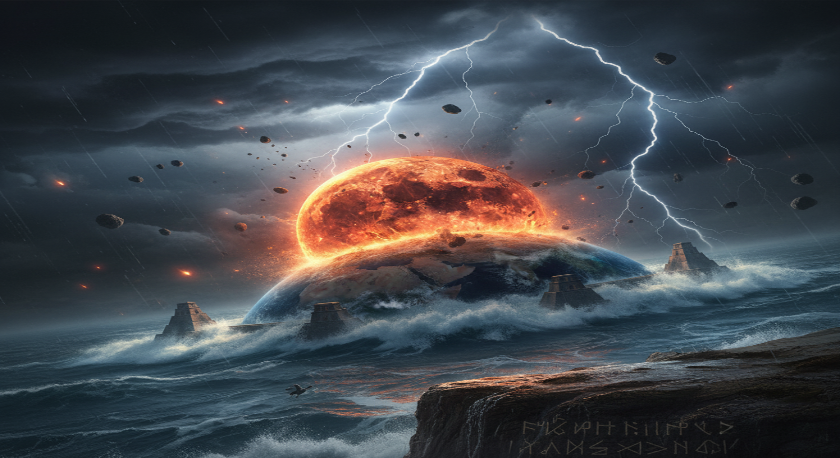
The Silent Eons of Pre-Lunar Earth
Of all the celestial bodies that govern our lives—the tides, the cycles, the very rhythm of time—the Moon is the most constant. It is the sentinel in the night sky, yet ancient records from around the globe tell a chilling story of a time when our Earth spun alone, bathed in a sun-drenched, moonless solitude.
The concept of a world without its great satellite—a time known to esoteric scholars as the era of Pre-Lunar Chronology—is one of the most provocative pieces of Forbidden Knowledge hidden within humanity’s oldest archives. For a more comprehensive study, see our article The Moon Before Time: An Examination of Pre-Lunar Chronologies. How could such a fundamental shift in our planetary mechanics be forgotten by standard history? This question leads us deep into a collision of myth, Catastrophic Cosmology, and modern astrophysics, suggesting that the Moon’s sudden appearance was not a gentle gravitational capture, but a dramatic cosmic upheaval that rearranged life on Earth.
Echoes of a Moonless Sky
The notion of a moonless past is not confined to a single culture but appears in scattered, profound fragments across various mythic traditions. These accounts uniformly describe the advent of the Moon as a disruptive, world-altering event, often marked by great floods, atmospheric chaos, and geological violence.
The Arcadian and Zulu Accounts
Among the Greeks, the Arcadians maintained a genealogy that proudly declared their ancestors, the Proselenes (or “Before-Moon people”), inhabited the region when the sky held no moon. Plutarch and Apollonius of Rhodes both reference this tradition, lending credence to the idea that this memory persisted even into classical antiquity. Similarly, certain ancient Zulu myths speak of an epoch when the heavens were barren. These accounts depict the Moon as a celestial dragon or a disruptive entity, pulled violently into orbit, causing massive global tremors and environmental destabilization.
Zoroastrian and Early Hebrew Gaps
The Zoroastrian texts, particularly the Bundahishn, reference a primordial cosmic battle involving a powerful destructive force that altered the shape of the heavens. While often interpreted spiritually, these myths can be read as a description of a major impact event. Furthermore, early textual analysis of the Book of Genesis reveals an ambiguous chronology in the creation of the lights in the firmament. Critics point out that the precise description of the Sun and Moon as being set in place to govern day and night comes after the initial creation of light, suggesting a later, specific act of celestial ordering that may reflect the Moon’s sudden arrival in Earth’s orbit, fixing a chaotic earlier phase.
The Great Sky Fall: Mythology of Impact
To understand the sheer magnitude of the event described in these ancient whispers, we must turn to the most detailed catastrophic narratives—those of Sumer and Babylon, where the concept of the celestial wheel was first codified. These texts do not merely describe the Moon’s presence; they describe its birth from violence.
Tiamat and the Enuma Elish
The Babylonian creation epic, the Enuma Elish, stands as a masterwork of Catastrophic Cosmology. It details the battle between the young god Marduk and the primordial saltwater goddess, Tiamat, whom Marduk slays. The myth is explicit: Marduk splits Tiamat’s body in two, using one half to form the sky and the other to form the Earth. But crucially, he sets up the heavenly bodies using Tiamat’s body parts. The myth recounts the creation of the “gates” for the Sun, Moon, and stars from the goddess’s remains, directly linking the foundation of our current cosmic order to a violent, splitting action in the heavens—a celestial catastrophe with unmistakable parallels to modern impact theories.
The Younger Dryas Boundary Layer
The mythic memory of a “sky fall” gains terrifying geological context when examined alongside the Younger Dryas impact hypothesis. This geological event, occurring roughly 12,800 years ago, correlates precisely with a period of sudden, dramatic global cooling and mass extinctions. Scientific evidence points to a significant cosmic airburst or impact event, characterized by the deposition of a vast boundary layer containing nanodiamonds, microspherules, and other impact proxies across North America, Europe, and Asia. If the Moon’s sudden arrival was indeed a later, secondary effect of a massive earlier impact—perhaps a companion body passing too close and destabilizing an already fragile environment—the ancient records perfectly describe the resulting planetary chaos.
Decoding the Spiritual Order
The Moon’s establishment in the sky was not just a physical event; it was a spiritual one, marking the transition from the chaotic, primordial age (the pre-lunar world) to the ordered, cyclical world governed by divine law. This is where Forbidden Knowledge intertwines with theology, often linked to the mythic figures like the Watchers, whose descent shaped the heavens and introduced cosmic disorder.
The Cosmic Clock and Tides
The Moon introduced regular tides, stabilized Earth’s axial tilt, and established the precise timing of months and seasons. For ancient civilizations, this shift was the very definition of order conquering chaos. Prior to the Moon, astronomical observation was irregular; afterward, predictable cycles allowed for the rise of advanced calendrics, farming schedules, and monumental architecture. The ancient records, therefore, treat the Moon as the definitive marker of history’s beginning, establishing the boundaries of time and space we still observe.
The Atmosphere and the Waters Above
In certain ancient cosmologies, particularly early Hebrew and Near Eastern traditions, the creation of the firmament involves separating “the waters which were under the firmament from the waters which were above the firmament.” Scholars interested in Catastrophic Cosmology have proposed that this separation might be a mythic description of a dramatic change in Earth’s atmosphere, perhaps the destruction of what was once conceived of as a tangible celestial structure. Reconstructing this Lost Firmament gives us a clearer picture of the pre-Moon sky. The catastrophic event that birthed the Moon could have stripped away a denser, water-rich atmosphere, or radically altered the planet’s magnetic field, leading to the atmospheric and hydrological changes the myths describe as divine reordering.
Theia’s Ghost and Modern Astrophysics
Modern science offers its own dramatic narrative for the Moon’s formation: the Giant Impact Hypothesis. In this leading theory, a Mars-sized proto-planet named Theia collided with the early Earth roughly 4.5 billion years ago. The debris from this massive collision eventually coalesced to form the Moon.
Bridging the Time Gap
While the Giant Impact Hypothesis places the Moon’s origin in deep history, the persistent ancient records of a moonless Earth and a violent, recent arrival present a chronological paradox. Could the ancient accounts be describing a much later secondary event—such as a subsequent close pass or the orbital stabilization of the Moon—that dramatically affected Earth, but centuries after its actual formation? Or is it possible that our scientific dating of this catastrophic cosmic formation event is incomplete?
The Quest for Forbidden Knowledge
The power of the Pre-Lunar Chronology myths lies in their unity. Separated by continents and millennia, these cultures share a specific, unusual memory: that the greatest light in our night sky was once absent, and its arrival was a cataclysm. Whether the myths record a recent, devastating orbital shift that coincided with the Younger Dryas extinctions or preserve a truly ancient, primeval memory of the Moon’s genesis, they compel us to view the boundary between myth and science not as a barrier, but as a lens. They are history’s attempt to preserve the record of a true celestial catastrophe.
Final Thought:
The Moon, often seen as a symbol of tranquility and cyclical harmony, may actually be a monument to planetary violence and the ultimate testament to cosmic survival. By listening to the ancient records—those whispers of a moonless sky and a disruptive celestial birth—we uncover a history where the lines between the sacred and the scientific vanish, revealing a single, dramatic truth: our existence is inextricably tied to the rhythms of Catastrophic Cosmology.